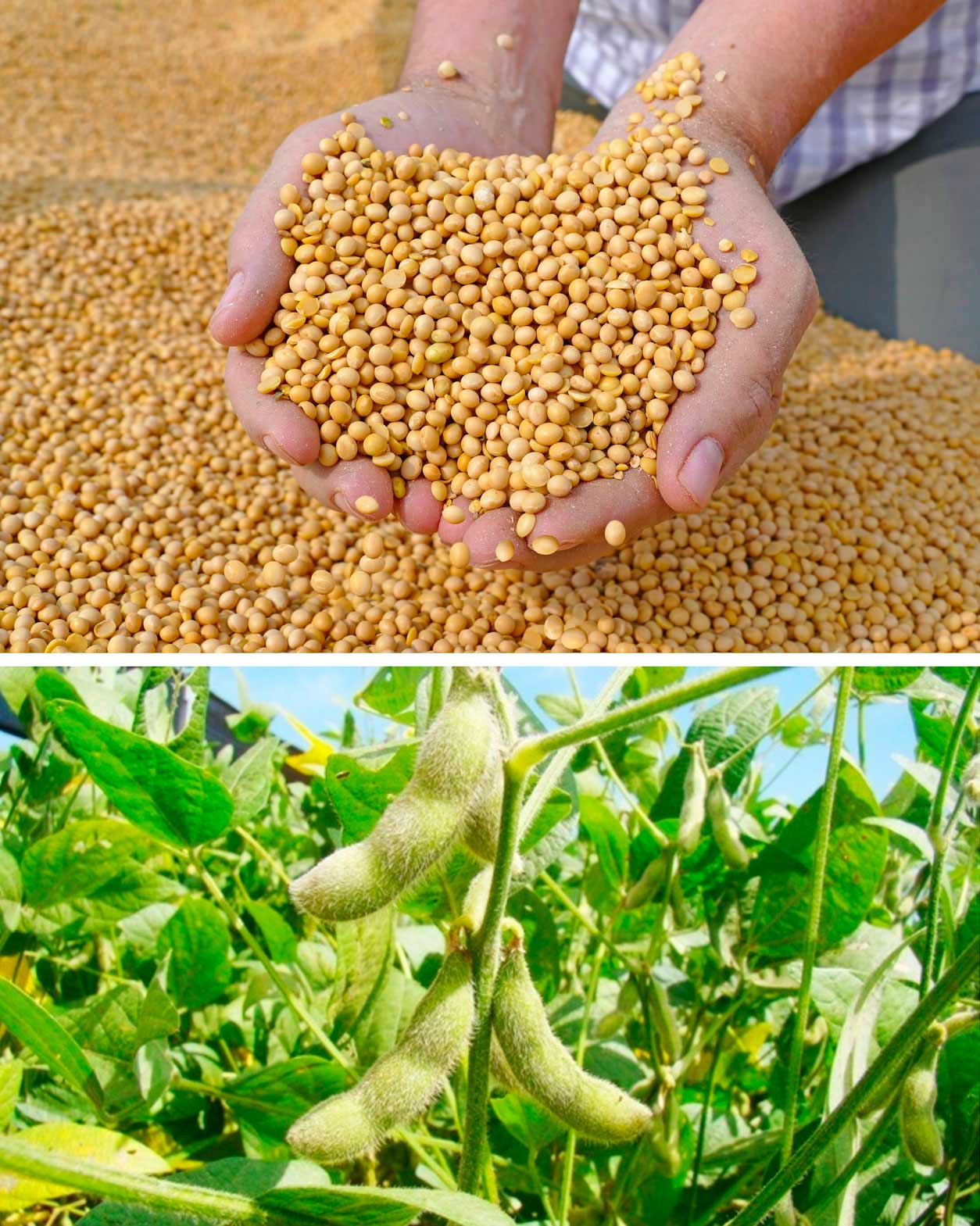
Annual herbaceous plant, spring-summer, whose vegetative cycle ranges from three to seven months and from 40 to 100 cm in wingspan. The leaves, stems and pods are pubescent, the color of the hairs varying from blonde to more or less grayish brown.
Description of the Product
CHARACTERISTICS AND PROPERTIES OF SOYBEAN
SOY or SOYA is a legume of the papilionaceae family, to which well-known plants such as beans and peas belong. Soybean (Glycine max) is an annual plant up to 1.5 m tall. Erect stems covered with thick brownish hair. Leaves alternate, trifoliate with oval leaflets and short peduncles; the basal ones, simple. Whitish or white-purple flowers 5-6 cm long grouped in clusters. The fruits are legumes up to 7 cm long with one or four seeds inside. These have different colors depending on the variety in question (mainly yellow, black or green). It comes from the species Glycine ussuriensis that grows wild in China and Japan. Soybeans originate from Southeast Asia. We have remains of its existence in China more than 5,000 years ago and its use as food is documented in this country in the year 2800 BC. Since Eastern religions prohibited the consumption of animal meat, soy was imposed from the beginning as an essential crop in the East to supply the proteins that they could not acquire from meat. In fact, in these regions it is known as "field meat" or "Chinese beef." From there it was taken to Europe in the 18th century and to the United States at the beginning of the 19th century. It is in this country where its cultivation acquired greater importance within Western countries until it became the first producing country in the world and a great exporter to other countries that need it. Brazil is the second largest producer in the world before Argentina, surpassing China and India. In Europe the largest producer is Italy. Soy was and continues to be used in the East as a food, either in its simple form, as another legume or through some of its derivatives (Tofu, soy milk, soy sprouts, soy sauce, etc.) All of these products and, especially their derivatives, are increasingly spreading to other parts of the world. Soybeans, along with potatoes, corn and millet, constitute the staple foods in China. In the West, the use of this legume is mainly focused on the production of livestock feed, the production of edible oils or industrial lubricants, and vegetable fats both for food in the form of margarines and for industry, paints or other industrial derivatives.
FOOD AND MEDICINAL PROPERTIES OF SOYBEAN
A food rich in vegetable proteins The consumption of soy is considered in eastern countries as an alternative to the consumption of meat. It surpasses the rest of the legumes for its richness in protein and its complete range of essential amino acids. All of this implies that soy can replace meat or animal milk, making it a particularly recommended food for those people who decide to adopt a vegetarian diet or decide to do without part of the meat in their diet. 250 grams of soy provide 30% of the daily recommended amount. (See tables below for a comparison of the nutritional properties of soy compared to beef) If we compare it with chicken meat, its protein percentage is almost identical and is close to 40%. A legume very suitable for bone health Soy is very rich in calcium, with a content very close to that of cow's milk, so it can provide all the properties of this mineral and, at the same time, is especially suitable for those people who do not tolerate milk well or who cannot drink it because they have lactose intolerance, a component that this food does not have. We must not forget the importance of this mineral in people who have osteoporosis, especially menopausal women or older men. It should be added that, in addition to calcium, an isoflavone, called daidzein, also helps prevent bone decalcification since it reduces the loss of calcium from the bones themselves and its expulsion to the outside through urine. Eating this food regularly is a good way to keep bones in good condition and prevent fractures. A 250g serving of soybeans provides 50% of your daily calcium needs. We must not forget that it is also very rich in phosphorus, a mineral that is very important for the body since it contributes to the formation of bones after calcium and is involved in the formation of many enzymes, in addition to being important for good health. the nerves and the proper functioning of the brain. Soy is very good for circulation Soy is a very interesting food for circulation. It has been proven that replacing animal protein with this food can reduce blood cholesterol levels by up to 20%. The isoflavone genistein helps not only reduce cholesterol.